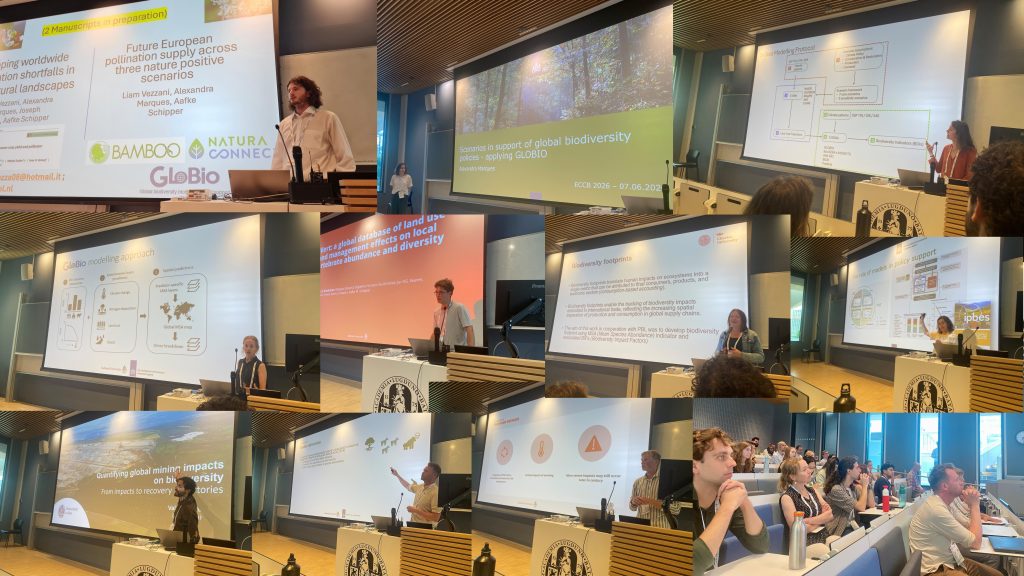
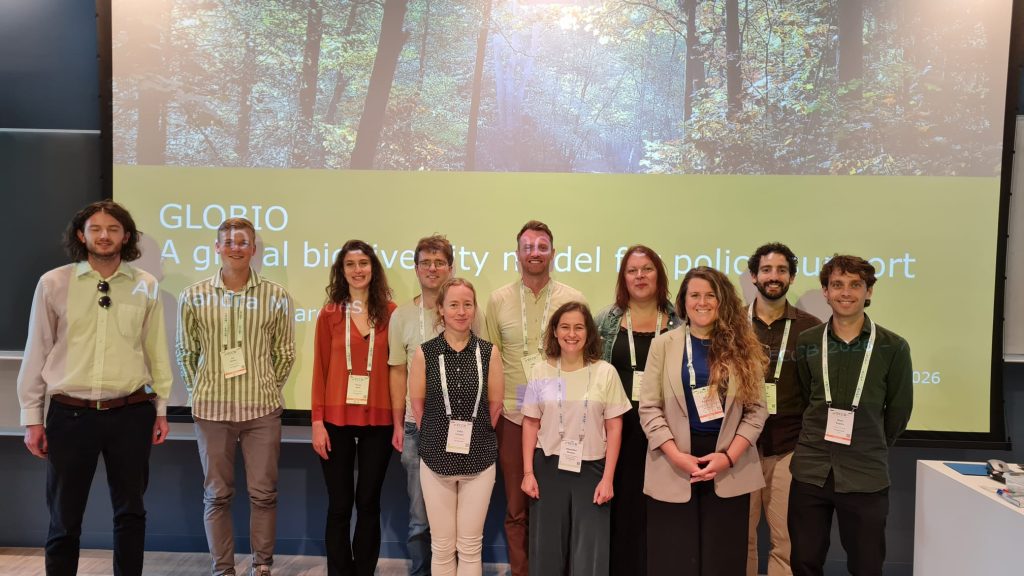
This year’s European Congress of Conservation Biology (ECCB) took place in Leiden, The Netherlands, and the GLOBIO team used the occasion to host a dedicated GLOBIO Symposium. This was a chance to share the model’s latest scientific developments and applications with the wider conservation community. The symposium brought together PBL’s team, close collaborators at Radboud and Leiden universities, and partners from Utrecht University and Charles University (Prague), and drew a full, engaged room throughout.
Model developments
Liam Vezzani (PBL, Radboud University) presented the new GLOBIO pollination model, built to map pollination shortfalls globally by linking spatial predictions of pollinator density with a new empirical global yield function: “It was valuable to receive constructive and critical questions from the audience, many of which aligned with considerations we had already discussed during the model’s development.”
Jelle Hilbers (Radboud University) presented GLOBIO-Species: “It was inspiring to see that such a large and diverse audience attended, highlighting GLOBIO’s strong recognition within the science-policy interface. I believe the stimulating talks and discussions during the symposium will help ensure its continued relevance and impact.”
Maarten Broekman (Radboud University) presented a recently published database on land use and management effects on biodiversity, and the first study built on it: “I received several questions and positive feedback on my presentation, which made it very rewarding. I also enjoyed hearing about the other research going on within the GLOBIO framework.”
Jur Seuren (Radboud University), presenting at his first scientific conference, shared his work on the climate vulnerability of freshwater fishes and how it feeds into the GLOBIO model: “The discussion session at the end offered interesting perspectives and potential future challenges and avenues. Interesting times lie ahead of us!”
Valerio Barbarossa (Leiden University) presented new work quantifying mining impacts on biodiversity across realms through a global meta-analysis measuring MSA change along a distance gradient from mine sites, plus two regional meta-analyses (Europe and Australia) quantifying recovery rates across different restoration practices over time: “The discussion at the end was one of the highlights for me, with lots of energy around where the model should go next. I am especially looking forward to seeing GLOBIO grow into a tool that can assess restoration and offsetting, which feels essential given the decades of restoration ahead of us under global and EU policy.”
Applications & policy
Alexandra Marques (PBL) presented an application of GLOBIO supporting the Convention on Biological Diversity, using scenario analysis to explore what implementing the Kunming-Montreal Global Biodiversity Framework would mean for biodiversity: “The combination of presentations on the model’s scientific developments and its applications in the science-policy domain was enriching and sparked very interesting discussions.”
Davina Vačkářová (Charles University) presented work on biodiversity footprints, showing how GLOBIO results can be used to assess the biodiversity impacts embodied in global supply chains: “It was inspiring to see the progress in GLOBIO modeling and its wide range of applications. The high quality of the presentations and discussions provided valuable insights and showed the important role of GLOBIO in supporting biodiversity research and policy.”
Aafke Schipper (Radboud University) presented the intactness-based biodiversity impact factors, which can be used in footprint analysis, for example quantifying the biodiversity footprint of products, sectors or consumers.
Flavia Aschi (Utrecht University) presented interesting preliminary results on a biodiversity intercomparison exercise: “I appreciated the active involvement of the audience in discussing future directions for model development, with many insightful ideas on how GLOBIO can continue to evolve and remain relevant at the science–policy interface.”
Reflections on the conference and what’s next
Koen Kuipers and Clara Veerkamp co-chaired the symposium’s closing discussion, where participants discussed future model developments and policy relevance. One of GLOBIO’s advantages, it was noted, is that it already includes many drivers of biodiversity loss, though pressures like invasive and alien species, or toxicity, remain important gaps. On the policy side, the Nature Restoration Regulation and recent developments in biodiversity credits were highlighted as key topics.
Koen Kuipers (Radboud University):“The feedback from conference attendees, combined with the many other interesting presentations at the conference, was very inspiring and helped to identify opportunities to further improve the GLOBIO modelling framework.”
Clara Veerkamp (PBL, Leiden University) also chaired a panel on biodiversity-inclusive urban planning and policy, timely given the team’s work on a new urban nature module: “I initially anticipated a focus on conservation biologists and ecologists discussing protected areas and specific species, but I was pleased to see a broader research landscape. It was rewarding to see the enthusiasm from colleagues across PBL, Radboud, Utrecht, Charles University, and Leiden in the GLOBIO symposium itself, with an attentive audience engaged throughout the full three-hour session.”