
Rising nutrient pollution threatens freshwater biodiversity
Excess nitrogen and phosphorus concentrations – mainly originating from agriculture, wastewater, and urban runoff – are posing a major threat to freshwater biodiversity across the globe. Therefore, it is important to understand how nutrient pollution may affect the biodiversity of lakes and rivers in the future. In this new study, we assessed how freshwater biodiversity intactness could change in the coming decades under three widely used future development scenarios: a sustainability-focused world (SSP1), a fragmented and regionally focused world (SSP3), and a fossil-fuel-driven development world (SSP5). Using data from hundreds of nutrient-addition experiments worldwide, we developed new global relationships linking nitrogen and phosphorus concentrations to freshwater biodiversity intactness, as expressed with the Mean Species Abundance (MSA) indicator. We then applied these relationships to global SSP-based nutrient concentration maps to estimate potential future changes in freshwater biodiversity.
The results are sobering, with all three scenarios in our study showing declines in global mean MSA values. We found the smallest mean decline in the sustainability scenario and the largest in the regional rivalry scenario, with weak environmental governance leading to higher pollution levels. The strongest declines are projected for African river basins such as the Nile and Congo. In contrast, for some river basins in Europe, North America, and parts of Asia – such as the Rhine, Mississippi, Yangtze, and Ganges – we found moderate recoveries, especially in a sustainability-oriented world. Overall, our study shows that reducing nutrient pollution is critical for protecting freshwater biodiversity in the coming decades, underscoring the urgency for pre-emptive action in regions with high current biodiversity intactness.
Our newly developed freshwater nutrient–MSA relationships can be used to update the GLOBIO-Aquatic model, enabling researchers to better assess the effects of multiple human pressures on freshwater ecosystems. Currently, GLOBIO-Aquatic estimates impacts of eutrophication using the land use in the surrounding catchment as a proxy. Our novel MSA response relationships enable a more direct approach, opening the door to integrated global assessments that better capture how eutrophication affects freshwater biodiversity across the globe – and how targeted nutrient reduction policies can help to reduce biodiversity loss.
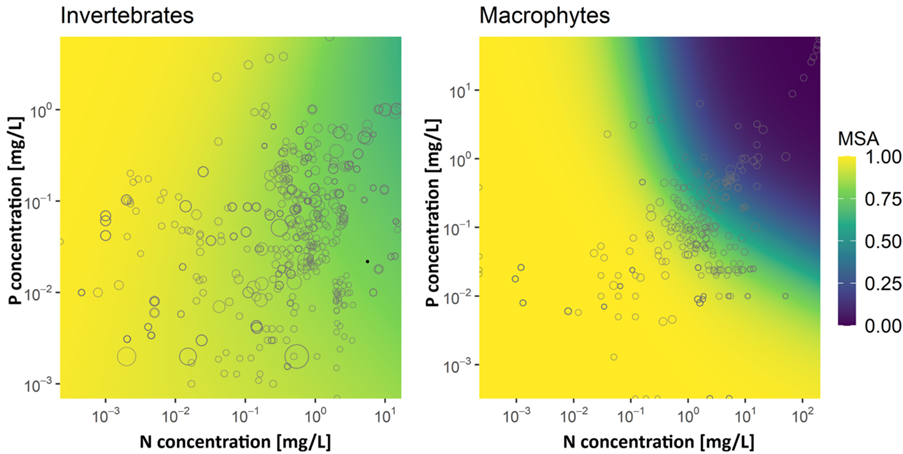

Authors: Floris K. Neijnens, Selwyn Hoeks, Hadassa Moreira, Koen J.J. Kuipers, Arthur H.W. Beusen, Gertjan W. Geerling, Mark A.J. Huijbregts and Aafke M. Schipper
Related publications:
 Threats of global warming to the world’s freshwater fishes
 Global Assessment of Plant and Animal Community Responses to Forest Management Over Time
 Impacts of current and future large dams on the geographic range connectivity of freshwater fish worldwide
 New paper on freshwater fish diversity patterns