Human impacts and vulnerabilityThe human enterprise rely on many goods and services from nature to sustain the entire demand for food, fuels, water, medicine, fibre and electricity. Human vulnerability to the state of the environment depends directly upon the ability of the environment to supply the essential basic needs for humans, as well as on the economic and social capability of the individual to cope with environmental degradation. Herein, we provide an overview of the human vulnerability to the state of the environment.
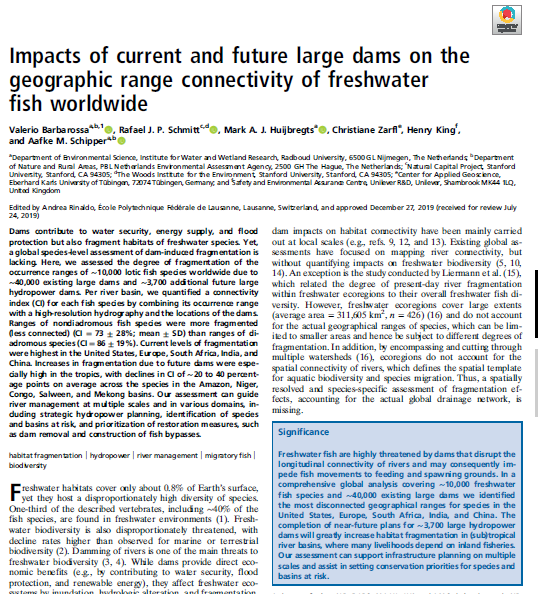
Furthermore, the many dams intended to supply water for irrigation and non-fossile hydropower result in decreased water supply further down stream, high methane emissions from some reservoirs, and draining of wetlands with enormous impacts on biodiversity and migratory species. Development of roads in semi-deserts and grasslands are often made for mineral extraction, but also result in increased human immigration and increase in livestocks, changes in nomadic systems and composition of livestock, with resultant desertifiion, thereby weakening the ability of these areas to sustain human populations.The Future: development and resources Currently, approximately 1/3 of the land area is directly converted to agricultural lands. More than 40% is under conversion and fragmented, and less than 25% remains intact. The majority of this is however located in the Arctic and in deserts. With current rates of development, particularly in South-East Asia, Africa and in Latin-America, the remaining forests and productive grasslands are being converted or made un-productive at a rate of 0.5-1% annually. In less than 50 years, the growth in human pressures resulting from both population growth and increasing resource consumption will seriously impact 50-90% of the land area in developing countries primarily by reducing land productivity and water resources. Global climate change is likely to exacerbate these impacts. While world food production still increases, the reduction in undernourished people is still only 27% of the goals set by the UN. More than 800 million people were undernourished by the turn of the millenium, and more than 1.7 billion suffered from lack of good drinking water. The expansion of the human enterprise is putting increasingly greater strain on exactly those resources supplied by the environment to sustain mankind. Close to 70% of the water consumption is related to irrigation, and water reservoirs are increasingly endangered by pollution, including waste and toxic chemis. The increases in food supply food supply from marine and coastal ecosystems is now the lowest in 50 years. As much as 40-50% of the marine fisheries were either depleted, overexploited or at their limit. In spite of demands, nearly one third of the landings are disded for commercial reasons.
The worlds greatest killer and greatest se of ill-health is poverty. Land and water degradation has its greatest impacts on the poor and in developing countries by increasing poverty, reducing labor productivity and exacerbating current economic and social crisis. Hence, environmental degradation is also affecting the economy, health and in-equity of people. Indigenous people and the poor are particular vulnerable, and will pay the greatest price in terms of their health, lives and cultures to a degrading environment. At the same time, developing countries facing some of largest population pressures and environmental problems are also those with the least economic capability - both national and for the individual - to cope with the environmental degradation.Threats to biodiversity
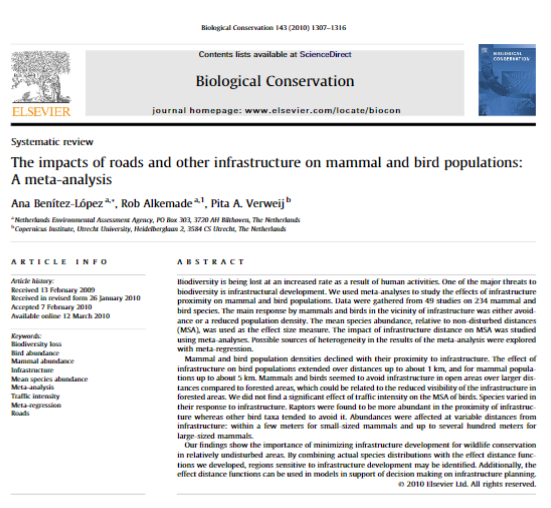
Animals avoid areas near infrastructure, breeding success decreases in developed areas, and habitats become fragmented. The ecologi impacts of losses of habitats and redistribution of animals away from development may again affect foraging success or survival substantially in areas beyond these initial zones of disturbance, and, hence, result in overgrazing, erosion, changes in predation pressure and breeding success. Avoidance of developed areas therefore affects much larger areas than that of the physically altered footprint of development. The extents of the zones within where wildlife will become affected by infrastructure vary according to species, season, type of disturbance, habitat, and other environment factors. The effect of anthropogenic development is thus species specific; while specialist species seem to avoid developed areas, generalists are more tolerant and may even benefit from human development. While some studies have suggested that wildlife and industrial development are highly compatible all in all, however, studies including both specialist and generalist species conclude that total species diversity declines with increasing anthropogenic development. Construction of roads, flooding, and/or changes in vegetation composition may also affect fledging success of birds and nesting waterfowl, which in turn may disrupt predation patterns and long-term productivity of smaller predators. The impacts on soils, vegetation, and wildlife are therefore often linked. The cumulative effects of these disruptions in ecosystem function are thus likely to exacerbate the impacts associated with changes in use and abundance of selected species. The outcome is that infrastructure, by propagating the entire human associated activity, is the leading se of loss of biodiversity.Global challenges At a global se, a substantial decline in abundance and diversity in fauna, including insects, amphibians, reptiles, mammals and birds, will occur in an estimated 50-90% of the land area in 2050 if growth in infrastructure and exploitation of natural resources continues at the current rate. Some species will increase in numbers, particularly "generalist" species such as smaller predators and "pest" insects, with subsequent impacts on flora and fauna. The environmental impacts of continued growth in infrastructure with its associated resource exploitation will also threaten the production of food and water resources and other essential products from nature. There is a significant risk that the cumulative impacts will lead to the collapse of many natural buffer mechanisms within 50-100 years, and, hence, substantially exacerbate the impacts of pollution and climate change. The greatest challenge ahead will become to harmonize and integrate assessments to better visualize and communie the relationship between economic, environmental and social stability. ![]() Detail of impact map |
|
Global Methodology for Mapping Human Impacts on the Biosphere
| ||
|