
The first comprehensive quantitative meta-analysis of global biodiversity scenarios
Internationally, it has been agreed to halt and reverse biodiversity loss, a commitment partly underpinned by model-based scenario analyses showing that bending the trend is possible. These scenarios provide insights into alternative future biodiversity trends and their drivers.
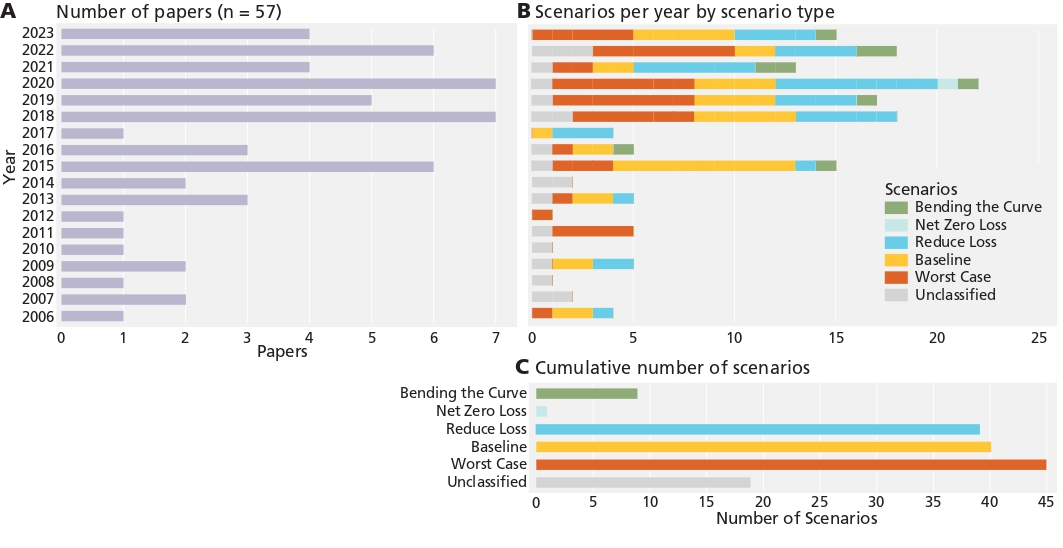
Our meta-analysis differentiates scenarios that project biodiversity loss and that halt or reverse the trend based on their quantitative outcomes and explores their key characteristics such as scenario assumptions, drivers of loss, biodiversity indicators and models used.
The study founds that GLOBIO was the most commonly used biodiveristy model. We also observed that “bending-the-curve” studies are scarce and often do no account for climate change, which risks giving the impression that reversing biodiveristy trends is easier than it actually is. Our findings indicate that bending the curve is only achievable through integrated efforts across multiple sectors, including nature conservation, sustainable food production, dietary change, and reduced food waste.
To better support policymaking, we recommend that scenarios should be based on model intercomparisons and use standardize indicators to allow comparisons across studies, account for additional drivers of loss to better capture the real threats to biodiversity, and include more ambitious cross-sectoral actions to effectively bend the curve.

Authors: Flavia Aschi, Stefan C. Dekker, David Leclère, Alexandra Marques, Christian Neumann, Geanderson Ambrosio and Detlef P. van Vuuren
Related publications:
 Spatially divergent impacts of global nutrient emission scenarios on freshwater community intactness
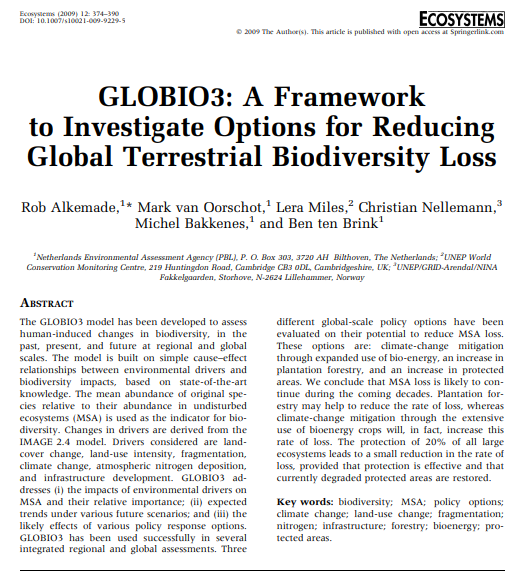 GLOBIO3: framework to investigate options for reducing global terrestrial biodiversity loss
 Pathways for agriculture and forestry to contribute to terrestrial biodiversity conservation: A global scenario-study
The Many Pathways of Mining Impacts on Biodiversity
Pathways for agriculture and forestry to contribute to terrestrial biodiversity conservation: A global scenario-study
The Many Pathways of Mining Impacts on Biodiversity